

Amos & Andrew (1993) (BLU-RAY REVIEW)
Director: E. Max Frye
Starring: Nicolas Cage, Samuel L. Jackson, Michael Lerner
RATED: PG-13/REGION 0/1:85/1080P/NUMBER OF DISCS 1
AVAILABLE FROM MGM

In the vibrant tapestry of early ’90s cinema, “Amos & Andrew” emerges as a curious blend of comedy and social commentary, though not without its quirks and stumbles. Directed by E. Max Frye and featuring the charismatic pairing of Nicolas Cage and Samuel L. Jackson, the film attempts to navigate the murky waters of race relations and identity in a predominantly white neighborhood, with mixed results.
At its core, “Amos & Andrew” tells the story of Amos (Samuel L. Jackson), an African American writer who unwittingly becomes embroiled in a series of comedic misunderstandings when Andrew (Nicolas Cage), a white man, mistakenly believes he can simplify Amos’s complex life. The film tries to tackle racism, privilege, and the absurdities of bureaucratic systems, offering a unique premise that occasionally drifts into farce. While the intentions are noble, the execution often falters, with moments of genuine poignancy overshadowed by sitcom-esque resolutions. The film grapples with heavy themes, such as how perception shapes reality, but it sometimes loses its way in favor of comedic hijinks that feel dated by modern standards.
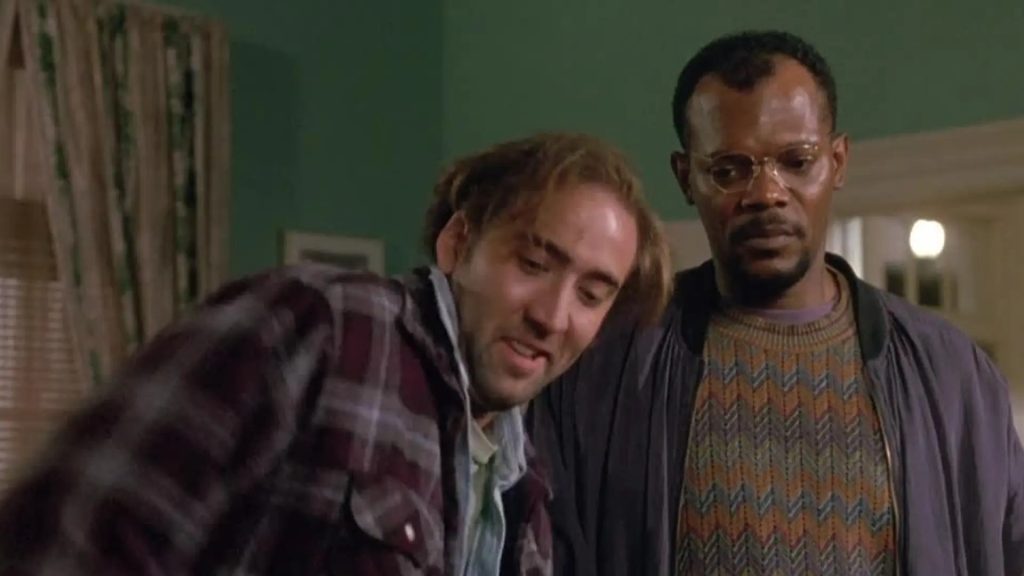
Cage and Jackson bring undeniable chemistry to their roles, and their sharp comedic timing serves as the film’s saving grace. Cage, in his signature flamboyant style, captures Andrew’s crumbling facade with a blend of intensity and absurdity, while Jackson’s portrayal of Amos is grounded and relatable—an anchor in the chaos. Their dynamic is a pulse of the film, often illuminating the absurdities of their circumstances. However, the supporting characters are less fleshed out, serving more as caricatures than complex individuals, which diminishes the narrative’s impact as it leans on tropes rather than character depth.
Frye’s direction walks a tightrope between satire and slapstick, and while he stumbles at times, there is a certain charm to the film’s curious rhythm. He captures the sunny yet oppressive atmosphere of the suburban backdrop, contrasting the light-hearted hijinks with undercurrents of tension that mirror the world outside. The cinematography, while not groundbreaking, effectively showcases the vibrant chaos through a palette that mirrors the characters’ erratic journeys.

“Amos & Andrew” is a movie that undoubtedly aims to provoke thought while still making one chuckle, yet it dances around its more significant themes without fully committing to a deeper exploration. The film evokes a sense of nostalgia—for a time when these conversations were just beginning to surface in mainstream media—but it also serves as a reminder of how far we’ve come and how far we still have to go. Despite its uneven execution, this flawed gem offers a glimpse at two icons before they fully embraced their potential, and therein lies a charm that resonates deeply. It may not stick in the mind as a classic, but it certainly leaves behind traces of laughter, reflection, and the realization that comedy and critique can indeed coexist—if only for a moment.